
The browser is no longer just a gateway to the internet. In 2026, it is becoming an intelligent interface one that interprets, summarizes, and even acts on information. Within this shift, a new category has emerged: AI-native browsers. Among them, Comet AI Browser is gaining attention as a product designed not to add artificial intelligence as a feature, but to build the browsing experience around it.
Comet positions itself as a next-generation browser where search, navigation, and productivity converge into a single AI-driven workflow. Instead of moving between tabs, tools, and search engines, users interact with a centralized assistant that processes context in real time.
This is not an incremental upgrade. It is a structural redesign of how browsing works.
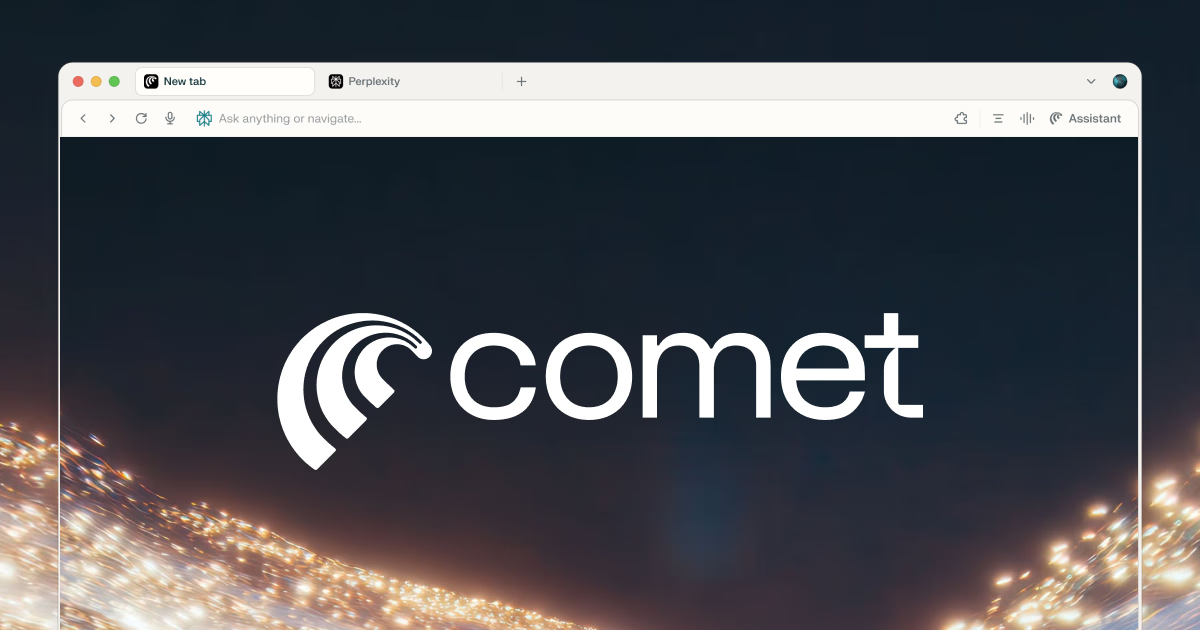
The Shift From Traditional Browsing to AI-First Navigation
For decades, browsers followed the same model. Users opened tabs, searched manually, compared sources, and extracted information themselves. Even as performance improved, the fundamental interaction did not change.
AI disrupts that model.
Comet AI Browser replaces the traditional search-and-click loop with a query-and-response system. Instead of opening ten tabs to research a topic, users can ask a question and receive synthesized answers, complete with context and references.
This approach reflects broader trends in digital behavior. Studies show that users increasingly prefer summarized information over raw search results. Time spent navigating between pages is declining, while demand for direct answers is rising.
Comet is built around that expectation.
Core Features of Comet AI Browser

At its core, Comet integrates several AI-driven capabilities into a unified interface.
The most visible is its conversational assistant. Users can interact with web content directly, asking for summaries, explanations, or comparisons without leaving the page. This reduces the need for manual research and speeds up decision-making.
Comet also introduces context-aware browsing. The AI remembers the user’s activity within a session, allowing it to provide more relevant responses over time. For example, when researching a market trend, the assistant can connect information across multiple sources without requiring repeated input.
Another key feature is task automation. Users can delegate repetitive actions—such as extracting data, drafting emails, or compiling reports—to the AI layer. This transforms the browser from a passive tool into an active participant in workflows.
Unlike traditional extensions, these features are embedded into the browser’s architecture, which improves speed and integration.
How Comet Differs From Other AI Browsers

The AI browser space has become increasingly competitive. Products like Opera One, Arc, and Brave have introduced their own AI assistants. However, most of these browsers treat AI as an enhancement rather than a foundation.
Comet takes a different approach.
Instead of adding an assistant to a traditional interface, it restructures the interface around AI interaction. The browser minimizes reliance on tabs and emphasizes a centralized workspace where information flows through the assistant.
This distinction affects usability. While other browsers still require users to manage multiple windows and tools, Comet aims to consolidate those functions.
The trade-off is familiarity. Users accustomed to conventional browsing may find the transition challenging. But for those willing to adapt, the efficiency gains can be significant.
Business and Productivity Implications

For businesses, the implications of AI browsers extend beyond convenience. They affect how work is performed.
Research tasks that previously required hours of manual effort can now be completed in minutes. Market analysis, competitor benchmarking, and content creation are increasingly automated within the browser environment.
This has measurable impact. Early adopters report reductions in research time and improvements in workflow efficiency. For teams managing large volumes of information, the ability to process data quickly becomes a competitive advantage.
Comet also supports collaboration indirectly. By structuring information through AI-generated summaries, teams can share insights more efficiently, reducing the need for lengthy documentation.
However, this shift raises questions about accuracy and oversight. AI-generated outputs must still be validated, particularly in high-stakes business contexts.
Privacy, Data, and Trust
As AI becomes embedded in browsing, concerns about data privacy intensify. Comet, like other AI-driven platforms, processes user queries and interactions to deliver personalized results.
This creates a tension between convenience and control.
Users benefit from contextual awareness, but they also generate more data. Questions about how that data is stored, processed, and potentially shared are central to adoption.
Comet addresses this through configurable privacy settings and transparent data policies. However, the broader issue remains unresolved across the industry.
In 2026, trust is becoming a key differentiator among AI browsers. Users are increasingly selective about which platforms they rely on for sensitive tasks.
Limitations and Challenges
Despite its promise, Comet AI Browser is not without limitations.
AI systems are not infallible. They can produce inaccurate or incomplete information, particularly in complex or niche topics. This requires users to maintain a level of critical oversight.
Performance is another consideration. Integrating AI at the core level can increase resource usage, particularly on lower-end devices.
There is also the question of dependency. As users rely more on AI-generated outputs, their ability to conduct independent analysis may diminish over time.
For businesses, these limitations highlight the importance of balance. AI can enhance productivity, but it should not replace judgment.
The Future of AI Browsing
Comet AI Browser represents a broader shift in how people interact with the internet. The browser is evolving from a navigation tool into an intelligence layer.
In the coming years, this trend is likely to accelerate. AI will not only summarize content but anticipate user needs, automate workflows, and integrate with other digital systems.
The distinction between browsing, searching, and working will continue to blur.
For companies, this creates both opportunity and pressure. Early adopters can gain efficiency advantages, while late adopters risk falling behind.
The Bottom Line
Comet AI Browser is part of a new generation of tools redefining how information is consumed and processed online. By placing AI at the center of the browsing experience, it challenges long-standing assumptions about how users interact with the web.
Its value lies in efficiency. Tasks that once required multiple tools and manual effort can now be handled within a single interface.
At the same time, it introduces new considerations around accuracy, privacy, and user behavior. As with any emerging technology, adoption requires careful evaluation.
What is clear is that the browser is no longer static. It is becoming intelligent, adaptive, and increasingly central to how work gets done.
In that transformation, Comet is not just another browser. It is a signal of where the internet is heading next.